

The Mouse Studies
What did Bill's first studies reveal about the impact of image cycling?

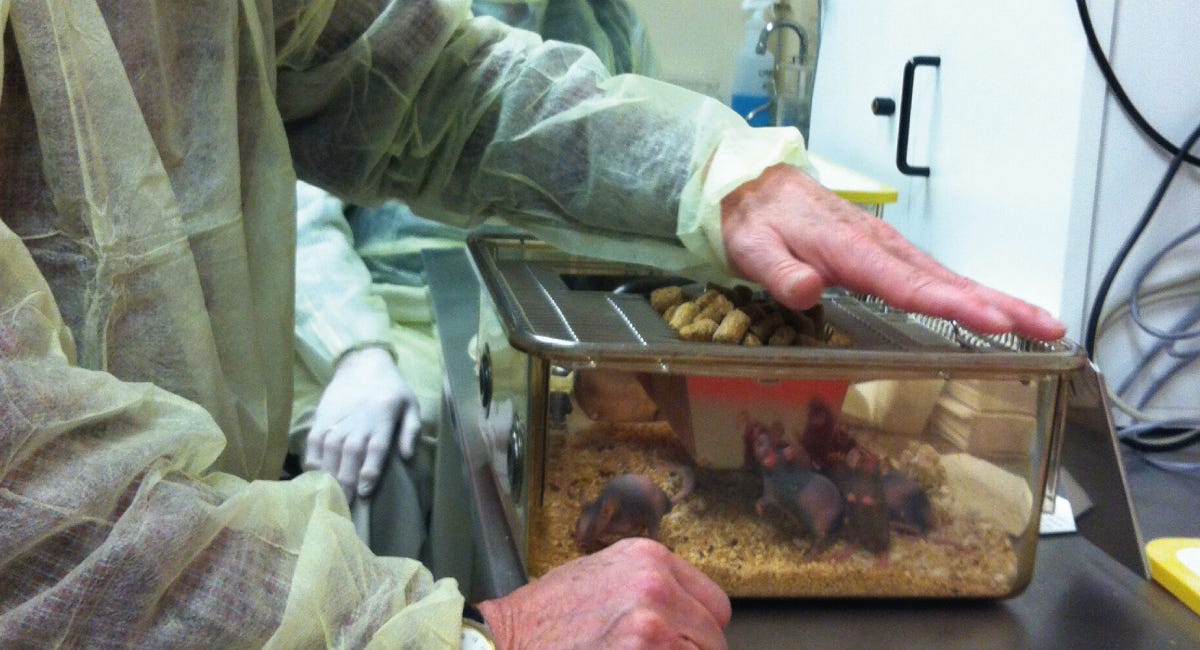
(photo of Bill treating nude mice)
Recently, a major paper was published out of MD Anderson Cancer Center that shared the results of The Bengston Method with pancreatic cancer in mice and in cell cultures. On Saturday, May 16, we’ll be doing a live Zoom event with both John Lavack, the main Bengston healer who was part of those experiments the last five years, and Margaret Nies, who can talk more the history of Bill’s research. The degree of statistical significance of Bill’s findings continues to be rare in the healing research field.
It all began in the 1980’s, when Bill found himself in a Queens College laboratory holding a cage of mice. These mice had been injected with a 100% fatal strain of mammary cancer. This was not his plan. Bill was a sociologist, not a healer. His plan was to study the healer Bennett Mayrick to see if he could collect data that would help him understand the real-world healing he’d witnessed by Mayrick and himself in humans. Ben had agreed to do the study, but then, as people sometimes do, he backed out at the last minute. The mice were already injected. Someone had to do something. Bill just didn’t think it would be him.
“You can do it!”
Bill’s friend and co-conspirator in this experiment was a geology professor named David Krinsley, and Dave was not about to give up so easily. With his encouragement, Bill reluctantly stepped in as the healer and so began one of the stranger scientific journeys in modern research — a decades-long series of healing experiments that produced full cures in a 100% fatal cancer model.
The first published findings appeared in the Journal of Scientific Exploration in 2000, co-authored by Bengston and Krinsley. The results were unambiguous. The mechanism of action was, and remains, genuinely unknown. They did not know why the “hocus pocus” (as Bill affectionately called his healing) cured the mice, and to this day, we still don’t know how this healing works, (although with the latest paper from MD Anderson, we are perhaps gathering some important clues).
The cancer strain they used in those initial experiments was H2712, a line of mammary adenocarcinoma that had been killing laboratory mice reliably for decades. Once injected, it grew and killed within 14 to 27 days in 100% of cases. Researchers typically chose this cancer model precisely because it had consistent lethal outcomes and was the most understood, widely published model for cancer mouse research.
In that initial study, Bill spent roughly an hour a day treating each mouse. Dave monitored them. Their working assumption was that healing, if it did anything, might suppress growth from the start. But that’s not what happened. Instead, the tumors grew and got quite large. It disturbed Bill enough that he repeatedly asked to euthanize the animals to end their suffering, but Krinsley persuaded him to continue.
By Day 14, the tumors were visible and large. By Day 22, they were larger still, but something odd was starting to happen at the surface. A blackened, encrusted area had formed at the posterior edge of each tumor. They initially mistook this for necrosis, but it wasn’t. It was the beginning of a remission pattern that would repeat, reliably, across four experiments at five institutions. The blackened area spread, ulcerated and then oddly the tumor appeared to resorb internally.
In that initial study, all five experimental mice went into complete remission.
One of the more interesting findings from all of this was not the healing in the subjects (as fascinating as that was), but the controls. Before he had backed out, Bennett had warned Bill not to keep the control mice in the same room he would be treating them in. “Don’t even let me see them,” he warned. Ben couldn’t explain why, but he believed proximity might affect the controls. Krinsley, skeptical, agreed to the protocol and housed the six control mice in a separate laboratory. Two of the six died on schedule. On time, within the expected window, as the model predicted.
Then Bill and Dave went to observe the remaining four control mice, which appeared quite ill whereas the treated mice, even with large tumors, were acting quite normal. Several days later, those four mice developed the blackened area. The tumor ulcerated. These four mice remitted — lagging behind the experimental group but fully recovering. They hadn’t been treated, yet still went to full cure.
The next obvious question was whether Bill unusual? Maybe whatever was happening was a property of one specific person and not repeatable by anyone else. The second experiment was designed to answer this question. Krinsley agreed to be part of the experiment himself and also recruited a skeptical Queens College faculty member. Bill recruited two of the most skeptical students he could find — students who, by their own later account, believed Bengston was doing a study in gullibility. They all trained for several hours a week over six weeks, learning the image cycling technique Bengston had developed. In this experiment, all seven experimental mice remitted. Four of six on-site controls went into remission, again after they were looked at by the students.
Bill continued his research moving to other institutions with similar results – treated mice went to full cure and control mice when viewed by a healer in the experiment also went to full cure. As each experiment completed and the data was collected, more questions were raised. What was apparent is the researchers had established reliable, on-demand production of remissions in mammary adenocarcinoma, replicable across multiple institutions, and that “the possibilities for research were almost endless.”
As Bill continued to research other mystifying and perplexing data appeared. We will be exploring this data and its ramifications in future posts.
These early mouse studies and those that followed over the next couple decades were the beginning and remain the foundation: controlled, peer-reviewed, and stubbornly real.
*Primary source: Bengston, W.F. & Krinsley, D. (2000). The effect of the “laying-on of hands” on transplanted breast cancer in mice. Journal of Scientific Exploration, 14(3), 353–364.*